

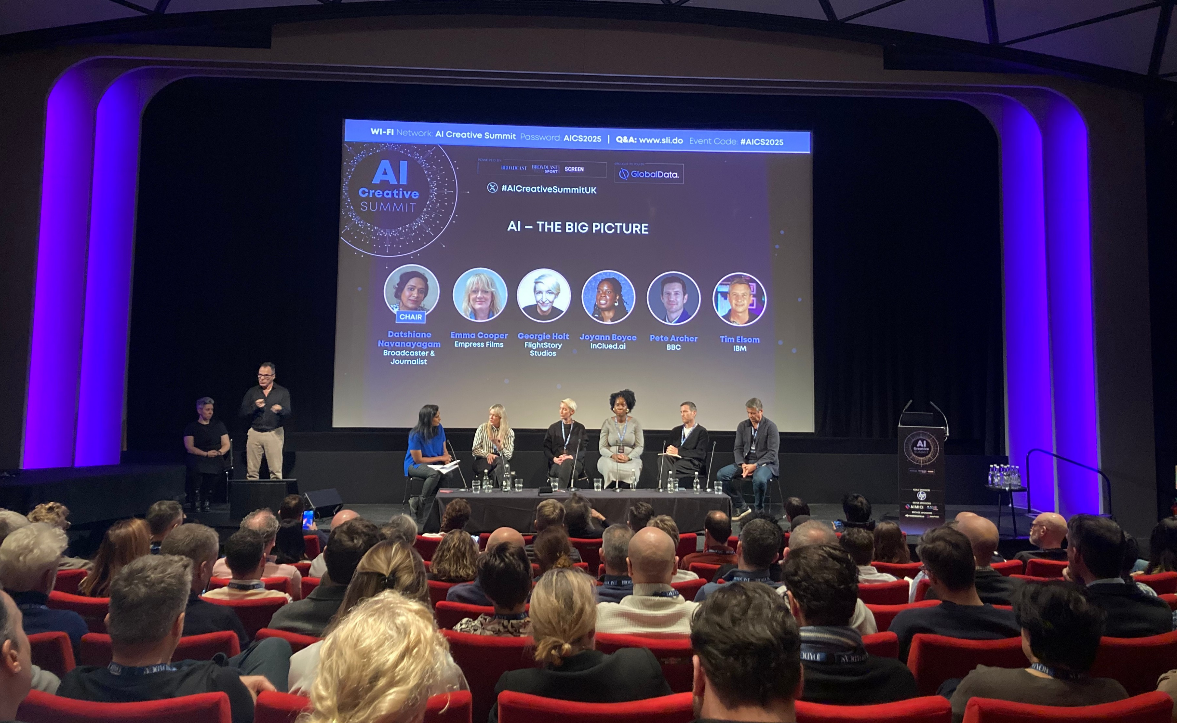
AI Creative Summit Organised by Broadcast
The conference began with a panel on the creative power of artificial intelligence. Alex Mahon, Chief Executive of Superstruct Entertainment, emphasised that developing the technology requires combining expertise in both technical and creative fields. As chair of the newly launched Centre for Creative AI, a collaboration between UCL, the Royal College of Art and The Brandtech Group, she outlined how the initiative aims to bring academia and industry together to drive innovation across entertainment, media, fashion, music and art.
Mahon observed the rapid growth of AI-generated content in marketing and advertising and the shift in skills required to use it effectively. Judgment, decision-making and taste will be as important as technical abilities such as editing. From her experience at Channel 4, she noted that although AI tools are improving quickly, output in broadcasting can still lack storytelling and often contains inaccuracies. Ultimately, she stated that audiences will decide its relevance; if people do not care whether something was created with AI, then it will not matter – the story remains paramount. She also reflected that, in some cases such as news, AI involvement should be credited.
How Professionals Use AI
The next panel explored how leaders are applying AI in their own work and how the UK can lead responsibly in innovation, regulation and rights. Emma Cooper, filmmaker, producer and founder of Empress Films, said creatives must take charge of AI tools. While the tools are not perfect, they can streamline workflows: they may not be ready to write full scripts but can support pitching. She expressed concern about young entrants to the sector and highlighted the importance of maintaining entry-level roles.
Georgie Holt, Co-Founder and CEO of FlightStory Studios stressed the role of leadership in coaching the next generation and the value of juniors learning closely alongside experienced professionals, who also benefit from fresh perspectives. Like Mahon, she highlighted the importance of understanding audience expectations and that FlightStory’s team often guides clients on what viewers are – and are not – currently ready for.
Joyann Boyce, Founder and CEO of InClued.ai, emphasised that AI systems can be biased because the data behind them is not always organised enough. She agreed that younger professionals often lack awareness of risks such as sharing personal information with models. Boyce advised testing prompts across multiple systems to mitigate risk.
Tim Elsom, Senior Executive Partner and AI Leader at IBM, said he has seen strong excitement in marketing departments, although he has not yet observed major job displacement. He described AI as a valuable tool to add to one’s skillset.
Pete Archer, Programme Director, Generative AI at the BBC, confirmed successful use of new tools in the newsroom, although human oversight remains essential. Responding to questions around trust, he acknowledged that AI poses challenges to journalism at national and local levels. The BBC clearly discloses when AI has been used, for example in translation, and maintains human checking. Archer also reported that around 20% of young audiences use AI tools to access news, and approximately 45% of that content contains at least one mistake. Copyrights remain critical, and he welcomed renewed government efforts in this area. He noted that one of the most significant shifts has been the reduced cost of producing podcasts.
Across the panel, there was consensus that AI is currently improving efficiency rather than replacing jobs – what it mainly removes is wasted time.

AI in Filmmaking
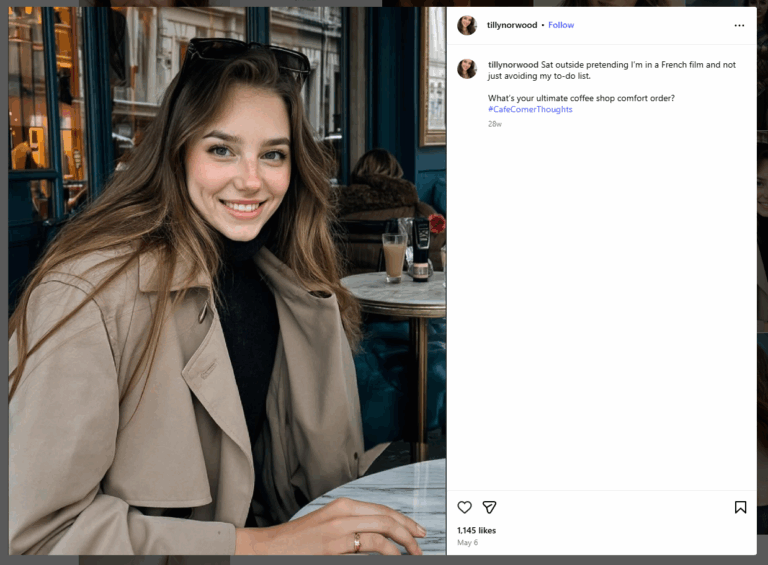
The following discussion involved filmmakers adopting AI in production. Eline Van Der Velden, Founder and CEO of Particle6, presented Tilly Norwood, an AI-generated character created this year. She described Tilly as an animation that still requires human care and creative direction and argued that this project will expand production, opening up new roles rather than removing them. She also pointed out environmental benefits, such as reducing travel, and said AI can support historical productions by recreating past environments. She was asked whether creating Tilly risked reinforcing a narrow female beauty ideal, but Eline responded that in her view it is still preferable to casting a human performer who has undergone extensive cosmetic procedures.
Matt Campion, Founder and Creative Director at Spirit Studios, explained that his team has been integrating AI across projects for three to four years. He highlighted its usefulness in pitching, and reviewing multi-camera material. Clips produced for Channel 5 demonstrated how reduced budgets can lead to new formats that may not otherwise exist. He added that repetition in factual and documentary, like using the same footage of burning house, content already existed long before AI.
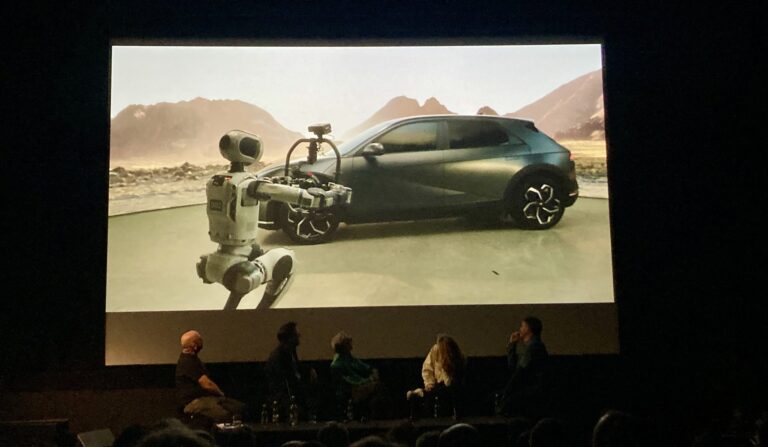
Award-winning director and DOP Brett Danton discussed new approaches to film production, presenting Atlas – a humanoid robot operated as a camera system. It enables shots impossible for human operators and can be deployed in hazardous environments. Drawing parallels with the introduction of drones, he noted that traditional craft still applies, but new skills will be required to control and direct these technologies. He echoed Mahon’s point that strong human judgment and taste remains essential.
Ethics and AI
The next panel turned to ethics. Will Hanrahan, Editor-in-Chief at FirstLookTV, explained how AI can support historical reconstruction. On one project, however, the team discovered that AI-generated faces bore strong resemblance to existing actors, prompting a shift towards creating models from their own material. In this case, it remained cheaper to use human performers rather than continuing with further development work with AI.
Voiceover artist Posy Brewer at SideKick Productions noted that synthetic voices have replaced performers in many areas and that she has personally had recordings used without payment. In some cases, she said, generating speech artificially takes longer than using real performers.
Liam Budd, Trade Union Official for Recorded Media at Equity UK, urged talent to scrutinise contracts carefully, as many unknowingly sign away voice rights. He highlighted the need for regulation and education around synthetic media, and Equity provides resources to support this.
AI Supporting Post-production
In the post-production session, Mo Abdelkhalek, Head of Product & Project Management at Dimension, described how AI is now used across the entire production cycle. They have experimented with location work, shooting material in London (just around the corner of their office) and transforming it into New York streets. However, human curation remains essential.
Donna Mulvey-Jones, Director of Post Production at Banijay UK, outlined extensive experimentation across production and post-production, and successful use of AI for content search, sound postproduction, object removal, and more. Banijay uses multiple AI models in parallel and performs A/B testing between them. She agreed that future teams will require new specialist skills to lead these processes.
Benjamin Field, Co-Founder and CEO at Deep Fusion Films, said the most effective approach is often to use different systems for different tasks and then combine the output. Like Mulvey-Jones, he emphasised the benefit in organising and searching archival material, generating possible subjects and drafting scripts – all within short timeframes (less than an hour) and with human oversight.
Daniel Oron, Co-Founder and Executive Producer at Go Button Media, stressed the need to track the terms and conditions for every AI model in use. His team regularly meets to review updates (sometimes weekly), acknowledging that tools evolve rapidly. He highlighted the responsibility of producers to stay informed.
AI Agents in Live Production
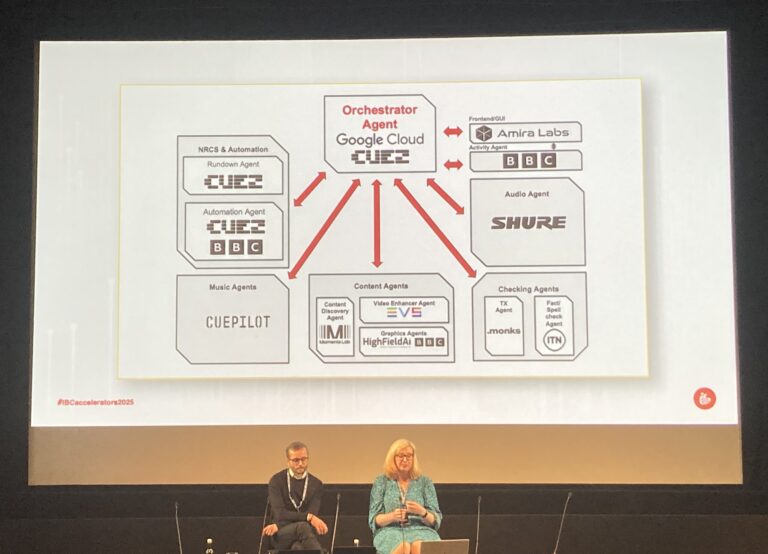
A particularly compelling session examined AI agents in live production. Jon Roberts, Chief Technology Officer at ITN, and Morag McIntosh, Solution Lead for Live Production Control at the BBC, presented the 2025 Accelerator Project, supported by Google and other partners. The initiative aims to automate parts of live production through a network of AI agents controlled by a central AI Assistant Director. By shifting from a traditional user interface to one directed through natural dialogue, operators can manage entire workflows in real time. The team demonstrated successful case study, and they will be developing projects further.
Who Is an Owner?
The closing panel focused on AI & copyright in film and TV. Joanna O’Sullivan, Head of Media Policy & Regulatory Affairs at ITV, said copyright is now a major challenge and acknowledged government recognition of the issue. She argued that while the sector generates substantial value, much of it does not return to the industry and must be better protected. She expressed surprise at how easily AI models creators can use online material without compensation, comparing it to a company expecting free office space or electricity. She cited example of YouTube that asked broadcasters to upload their shows there without relevant safety regulations.
Jack Jones, Partner at Sheridans LLP, argued that regulation should not be dictated from the top but instead shaped by industry needs. He said that the case it’s not only about copyright, but about all data online. Producers must ensure who own the material they create (including prompts), check freelancer agreements, review AI platforms terms & conditions and maintain appropriate insurance.
Alexandru Voica, Head of Corporate Affairs & Policy at Synthesia, agreed that video production is very complex and therefore harder to regulate. He noted the UK’s shortage of technology leaders and argued for the development of strong local companies to compete with global players, although he expressed doubt that this would happen soon.
AI in Micro-dramas
Juliet Riddell, Head of New Formats at the Financial Times, and Guy Gadney, Co-Founder and CEO at Charismatic.ai, discussed the use of AI in micro-dramas. Riddell showcased Recall Me Maybe, written by David Baddiel and produced by the Financial Times, which follows a grandfather living with dementia who uses AI to fill gaps in memory. She said the process was exciting, although the technology still has limitations.

Gadney reminded the audience that all systems carry bias because they are created by humans. He called for a greater number of models that reflect local cultures and perspectives. He is developing controversial project, a new format for dramas that will include 60 seconds long episodes targeted for 39+ females who are too busy to watch longer content.
In closing, ITN’s Jon Roberts highlighted the profound nature of the shift, noting that this is the first technology that can be used without needing technical expertise or any knowledge at all – something both exciting and unsettling.
Overall, the consensus seems to be that AI is opening new possibilities at the intersection of creativity and technology, although it seems to have its limits too – for how long, who knows. The only certainty is that change is coming, and those willing to learn and experiment could find that it brings opportunities rather than threats.